
When We Win features films, guest speakers, and community dialogue, these events provoke and explore vital questions about liberation, decolonization, and political commitment, and the realities of revolutionary struggle.
Throughout the year we will be exploring themes central to political organizing and community resistance, including:
- The centrality of land and place-hood
- Learning from ancestors
- Networks of solidarity
- Honoring survivors of state violence
- Imagining and envisioning the future
Together these films and the insights they offer invite us to ask: who are we struggling with, and who are we struggling for? How do we define our goals, and how do we achieve them? What is our vision for the future? What does winning look like?
The When We Win film series is a collaborative effort between the Freedom Archives, the Center for Political Education, and La Peña Cultural Center.
February
Films:
- Eyes of the Rainbow (1997)
- Selected feature from The Belly of the Beast
Gloria Rolando’s 1997 film offers an intimate interview with Assata Shakur who narrates her life story, reflects on her politicization within the Black Liberation Movement, and shares how living in Cuba expanded her cultural worldview and political commitments.
This main feature was complemented by an interview from Cuban news outlet The Belly of the Beast discussing how the Latin American School of Medicine (ELAM) exemplifies Cuba’s commitment to healthcare as a human right and demonstrates international medical solidarity.
Formerly-held US Political Prisoner Veronza Bowers opened the evening with a beautiful tribute on flute honoring Assata Shakur’s recent transition and her significance to all who struggle.
To close the evening Nathaniel Moore and Nadya Tannous spoke about how their experiences in Cuba deepened their commitment to fight in solidarity with the Cuban people and center internationalism in their political work.
Resources:
- Bay Area Cuba Solidarity
- Alliance For Cuba Engagement And Respect (ACERE)
- Global Health Partners
- Let Cuba Live!
- Interreligious Foundation for Community Organization (IFCO)
- The Belly of the Beast
March
Film:
- Mālama Mākua (2025)
Mālama Mākua is a community organization fighting for land reclamation in Mākua Valley, a region of Western O’ahu which has been occupied by the U.S. army since World War II. Laurel Mei-Singh’s film chronicles decades of diligent activism by the Mākua community towards the demilitarization of their land.
U’ilani Wesley, Executive Director at Xa Kako Dile community farm, joined us to reflect on the necessity of honoring the ‘āina (land) and people both of Mākua and in our own local communities.
The film was followed by a discussion about the ongoing struggle against the US military, the importance of intergenerational community-building and resistance, and ways we can support the people of Mākua.
Resources:
April
Films:
- The Land You Are On
- In the Land of My Ancestors
- Zuguleaiñ: hablaremos (“we will speak”)
The Land You Are On, produced by Sogorea Te Land Trust, introduced our April focus on Indigenous-led movements for cultural sovereignty and land reclamation. Illustrating the settler occupation of Turtle Island through maps and photographs, this video is a movingly succinct representation of both the scale of settler violence, and the endurance of Native resistance.
Kanyon Coyotewoman, the daughter of Anne Marie Sayers, introduced In the Land of My Ancestors, a documentary about Indigenous stewardship of Indian Canyon. A celebration of Sayers’ life and legacy, this film also highlights the land-based education, cultural programs, and activism led by the community in Indian Canyon.
Our full length feature, Zuguleaiñ: hablaremos (“we will speak”), documents language revitalization and land preservation work of the Mapuche people in Chile. We heard from filmmaker Kelly Baur and one of the Mapuche educators, Silvia Calfuqueo Lefio, in conversation with Vick Montaño from Sogorea Te.
Resources:
May
Film:
- Passion for Justice (1993)
On May 19th, When We Win celebrated four revolutionary ancestors: This is the shared birthday of Ho Chi Minh, Lorraine Hansberry, Malcolm X, and Yuri Kochiyama.
We were honored to be joined by Audee Kochiyama-Holman, who shared family stories and introduced the film Passion for Justice, which documents the life and work of her mother Yuri Kochiyama.
The film traces Kochiyama’s process of politicization and the deepening of her revolutionary convictions. Embodying a commitment to internationalism and cross-movement solidarity, Yuri’s work included decades of contribution to the Black freedom struggle, Puerto Rican independence movement, and support for political prisoners throughout the world.
Diane Fujino, Yuri’s biographer, joined us virtually to speak about Yuri’s commitment to struggle. Yuri was not a superhero, Fujino observed, but rather an “ordinary person who made extraordinary choices.”
Resources:
June
Films:
- I’m Free Now, You Are Free (2020)
- What These Walls Won’t Hold (2023)
I’m Free Now, You Are Free is a short documentary about Mike Africa Jr and his mother Debbie Africa – a formerly incarcerated political prisoner from the MOVE Organization. This film meditates on Black family preservation as resistance against the brutal legacies of state-sanctioned family separation.
Adamu Chan’s What These Walls Won’t Hold depicts life in San Quentin State Prison during the COVID-19 pandemic, combining Adamu’s media advocacy inside of San Quentin, personal experience surviving the pandemic and the stories of his friends and comrades attempting to secure their freedom. Grounded in personal narrative and intimate insights, the film is an expansive and candid glimpse into the realities of imprisonment and cross-wall organizing.
Adamu Chan was joined by UC Berkeley professor Dr. Ameer Loggins to discuss the crucial role of art and cultural preservation in social movements and community organizing.
Resources:
- I’m Free Now, You Are Free (2020)
- What These Walls Won’t Hold (2023)
- Adamu Chan
- Critical Resistance
- Ella Baker Center for Human Rights
July
Films:
- Maestra (Teacher) (2012)
- “Why this Cuban American Returned to Cuba After 20 Years Away | U.S. Voices Against the Blockade”
- “U.S. Policy Causes Cuba’s Blackouts. U.S. Citizens Bring Solar Panels for Pregnant Women”
Catherine Murphy’s documentary recounts and celebrates Cuba’s 1961 literacy campaign. In the wake of the revolution, over 250,000 volunteer educators mobilized throughout the island – teaching over 700,000 people to read and write. Through candid and intimate interviews with both teachers and students whose lives were changed through the program, this film shows how the education program was empowering for both students and teachers and instilled an enduring commitment to helping others as a central value in their lives.
The film was followed by two broadcasts from Cuban media outlet Belly of the Beast, documenting recent solidarity and aid campaigns in response to recent escalation and intensification of political and economic warfare by the U.S. against the Cuba.
We were joined by Corina Nolet, Co-Executive Director at Global Exchange, who had recently returned from Cuba on a diplomatic delegation. Her nearly two decades of experience organizing in solidarity with the Cuban people lent historical context and perspective to an urgent conversation about current conditions in Cuba, and how we in the Bay Area can support solidarity efforts.
Resources:
August
Film
- Free Joan Little (2025)
Directed by Yoruba Richen, Free Joan Little documents the 1975 case of Joan (pronounced Jo-Ann) Little. On trial for killing a white corrections officer as he violently assaulted and attempted to rape her, Little’s legal battle galvanzed a broad coalition of activists and supporters who fought alongside her against the compounding violences of state sanctioned sexual assault, racism, and the carceral state.
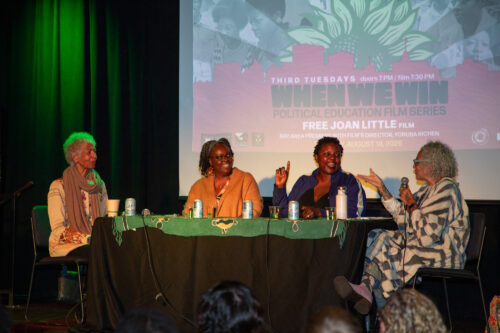
Following the screening we were joined by the film’s director Yoruba Richen, Janelle White (SF Women Against Rape), Aminah Elster (CCWP and Unapologetically HERS) and the legendary activist and former Black Panther Ericka Huggins. Speaking to the enduring relevance of Little’s case for comprehending conditions for women imprisoned today, this panel also invited the audience to share their own experiences participating in the Free Joan Little campaign, as well as those for women such as Inez Garcia and Dessie Woods, whose lives represent the epitome of speaking truth to power and personal and political fortitude.
Resources:
September
Film
- The Forest for the Trees (2006)
Our September film The Forest for the Trees tells the story of ecological activist and Earth First! leader Judi Bari, who worked to protect Northern California’s old-growth forests and who, as a former labor organizer, connected the struggle for the environment with the struggle of timber workers.
In 1990, Judi, along with passenger Darryl Cherney, were injured by a bomb planted in her car by the FBI. Claiming that the explosive had been Judi’s, Oakland police and the FBI arrested her. While the charges were never substantiated and the case against Judi was eventually dropped, Judi and the EarthFirst! community understood the implications of the attack against them as exemplifying extreme tactics of government repression and violence against activists that must not go unchallenged.
With the support of her comrades, Judi sued seven officers of the Oakland police department and the FBI. After a 12 year battle, their legal team successfully argued that Judi and Darryl had been framed and their First and Fourth Amendment rights violated by local and federal authorities. The jury ultimately awarded damages of $4.4 million. While sadly Judi did not live to see the verdict rendered, this powerful documentary chronicles the tenacity, commitment, and patience it took for an activist community to fight back and win.
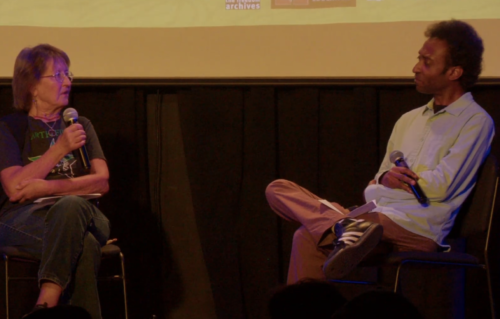
Following the screening we were joined virtually by Ben Rosenfeld, a member of Judi and Darryl’s legal team, who spoke via prerecorded interview. Ben cautioned that activists should explore a diversity of tactics and think creatively – while also accounting for the fact that we now live in a “proto-fascist and burgeoning police state” actively targeting protesters. We were also joined on-stage by Karen Pickett, a founder of Earth First! and friend of Judi’s, joined us to share memories of Judi’s life and work and the connections between this history and the present.
The evening ended with small group discussions, where we heard from several folks who had worked with Judi and Earth First!. The ongoing relevance of Judi’s story was brought to the fore by one attendee who connected the film’s events with the current worker strike against the Marathon refinery company in Martinez.