Introduction
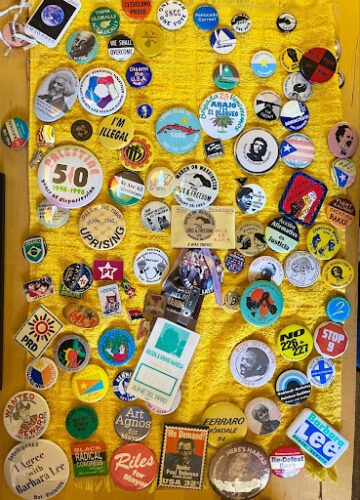
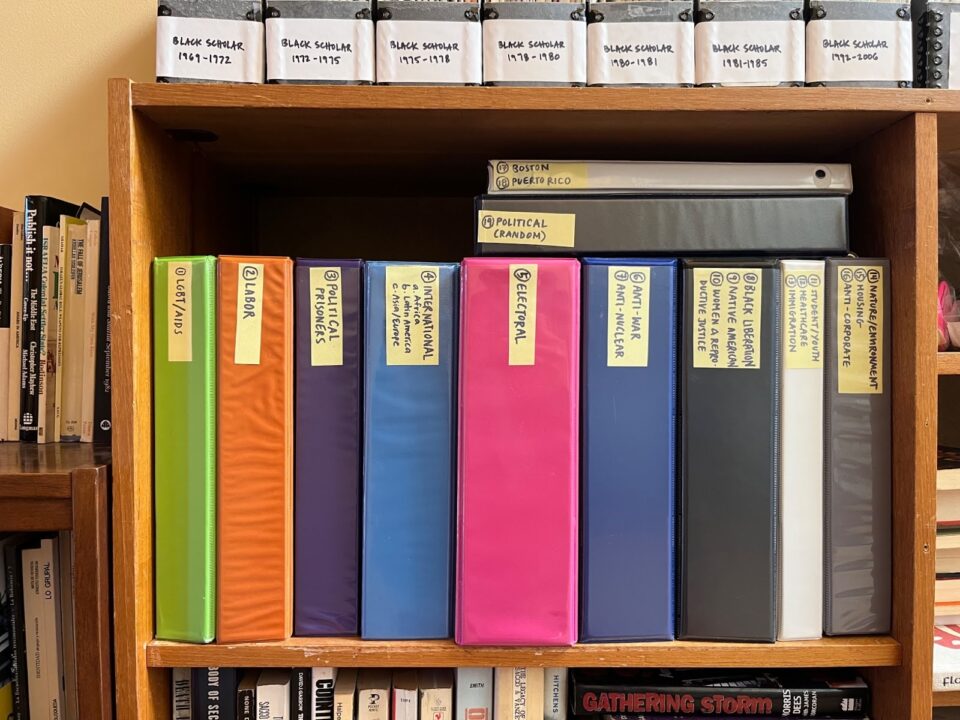
Since June, I have spent much of my time as a Freedom Archives intern working on processing the vast amount of pinback buttons donated to the archives. It has been a long journey of sorting through buttons and other miscellaneous items stored in ancient plastic bag homes, cataloguing (see Buttons Collection), and finally transferring the almost 900 buttons to a more permanent home (11 binders in the main hall of the archive)!
While less popular today than in the 1960s-90s moment, political buttons stand out as a way for people to communicate their political convictions. For such small objects, buttons communicate their messages strongly with bright colors, striking images, and bold lettering. Unlike branded t-shirts or jewelry designs, wearers can display many different buttons on worn objects, creating a visual map of their personal political commitments and a time capsule of changing conditions and resistance/action. Buttons are usually not made to be valuable, often passed out or sold cheaply so that more people can share the message, yet they stand out as lasting objects, easily stored when not needed and collected as mementos.
As objects in our archives, these buttons add a new layer to our audio-visual and paper collections: objects which distill events and movements into small packages and have been passed around, worn, and weathered. In combination with our other archived material, they present compressed symbols of various histories, summarizing the most urgent communications of their makers and sharing visual /design language of complex theories and movements. The events and organizations represented have passed or evolved since their making, but the impact of these objects remains as rich physical and visual evidence of movements and their global support networks.
HISTORY & SIGNIFICANCE
Pin-back buttons have always been political. They entered the mainstream through distribution by political candidates and supporters in the late 1800s, as a method of cheap and collectible promotion of political campaigns. Buttons became more focused on culture and counterculture movements with surges in the 1960s and 1980s, shifting away from collector’s items centered on presidential candidates and towards political and cultural event/organization mementos.
They have since become a key method of showing personal alignment with various causes and movements. Buttons hold important information about choices in design and trends in visuals and messaging, capturing key moments or catchphrases. They serve many different purposes, some examples shown below:
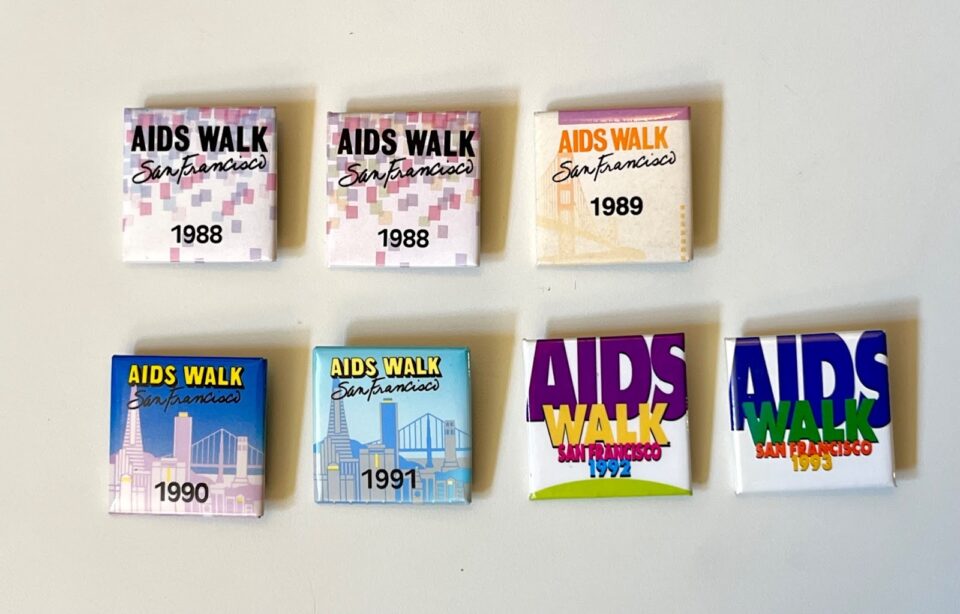
Commemorating Events: Aids Walk San Francisco, 1988-1993 The AIDS Walk in San Francisco began in 1987, as community members searched for ways to show support for friends and family devastated by AIDS. These buttons showcase designs from seven years of the AIDS walk.
The designs demonstrate shifting focus on simple text with abstract imagery, to an iconic view of San Francisco, and finally emphasis on the event name.
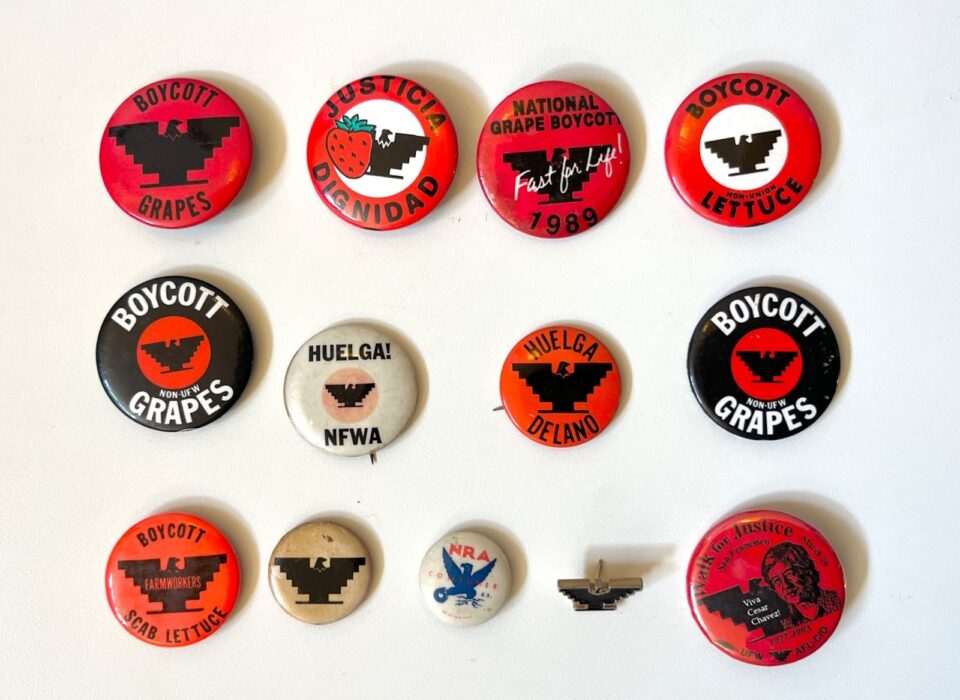
Propagating a Symbol: United Farm Workers Eagle
The United Farm Workers (UFW) emerged from the merging of organizations of Chicano and Filipino workers in 1966, led by Cesar Chavez and Larry Itliong. Richard Chavez, César Chavez’s brother, created the eagle symbol which would become iconic for UFW and Chicano culture more broadly. Drawing from Aztec imagery, the design was intended to be easy to replicate and with recognizable colors: “Black was for the workers’ desperation, white was for their hope, and red was for their sacrifice.”
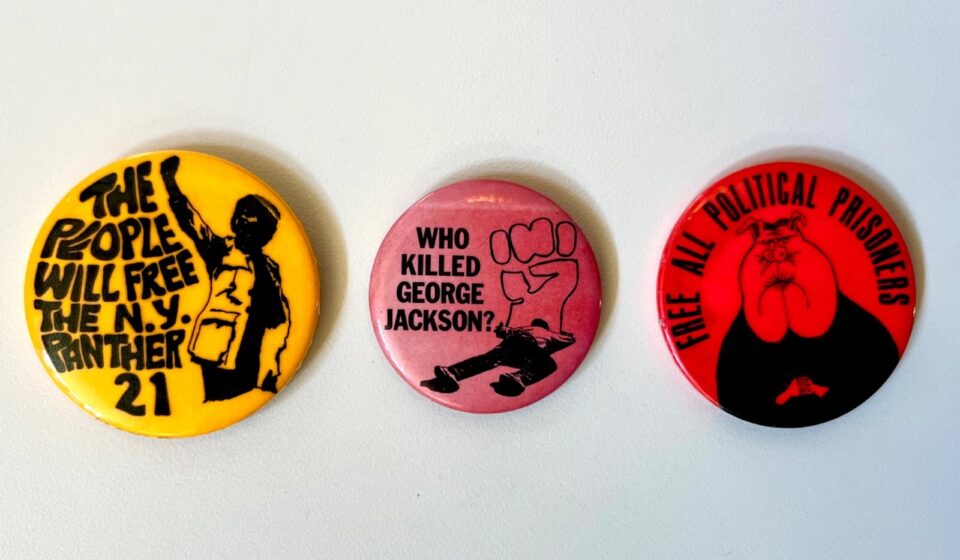
Gathering Support: The Panther 21
This piece centers on the New York Panther 21, a group of 21 Black Panther Party members accused of conspiracy to kill police officers and destroy buildings in April 1969. All were eventually acquitted. This object draws on language of movements, that it will be the people who will free the accused, not the criminal “justice” system that put them there.
THE COLLECTION
Freedom Archives’ buttons available for viewing and are organized into 19 subjects, numbered as follows:
- LGBT / AIDS
- Labor
- Political Prisoners
- International
- Africa
- Latin America
- Asia/Europe
- Electoral
- Anti-War
- Anti-Nuclear
- Black Liberation
- Native American
- Women & Reproductive Justice
- Students/Youth
- Healthcare
- Immigration
- Nature/Environment
- Housing
- Anti-Corporate
- Boston
- Puerto Rico
- Political (Random)
TAKEAWAYS
My personal interest in buttons started a few years ago, with a collection of political buttons shared with me through a program with the Asian American Resource Workshop in Boston, where movement elders brought their belongings to share as a “mini museum.” They had collected buttons from various moments and movements of the 1960s-80s across Boston and beyond, pinning them on a Mao-style jacket. Their pins symbolized their years of committed struggle, with personal and movement history commemorated in colorful designs of organizations and pithy political messaging.
While in my studies I read endlessly about figures, campaigns, and organizations, trying to understand what happened, when contained in a pin collection, it was so simple. All these movements and moments could not be considered in isolation. They overlapped, contradicted, built from one another, held both symbolic and material meaning, and were held and worn by people committed to broader ideals of justice and liberation. It happened, and then people continued to respond to the conditions they were facing. And 40 years later, in my relationships to these people and Boston, my commitments were part of their legacy of internationalism and Asian community power too.