As an intern in the Freedom Archives this summer, I had the rare opportunity and privilege to delve into the Bay Area’s progressive history in depth. There, rifling through dozens of newspapers, DVDs, periodicals, posters, and pamphlets, I found pieces of history that were far more relevant to the present than I could have anticipated.
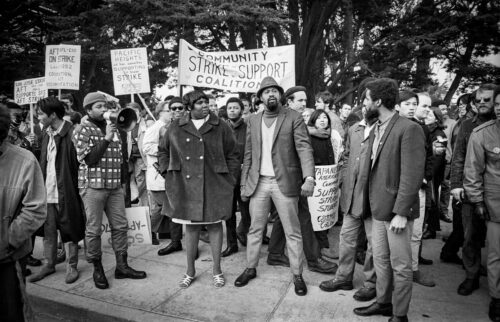
The late 1960s brought monumental changes to college campuses around the country — mainly sparked by non-white students growing increasingly frustrated by curricula that were not representative of their experiences or visions for the future. SF State’s Black student union — the first of its kind — initially demanded the reinstation of Black Panther George Murray’s professorship (who had been fired for encouraging black students to arm themselves) and the creation of a Black studies department, among other demands. In response to the lack of engagement by the administration, Black, Asian, and Latino students formed the Third World Liberation Front which demanded the rehiring of fired Latino and Black professors, the enrollment of more non-white students, and the creation of a new ethnic studies college.
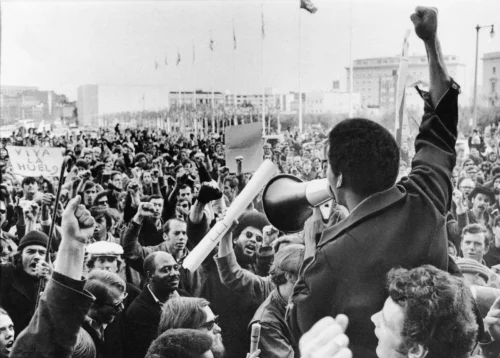
On November 6, 1968, SFSU students went on strike, shutting down almost the entire campus. Meanwhile, the TWLF and BSU held rallies on campus, went inside classrooms to disrupt classes, and occupied buildings. As the TWLF made itself visible and known, a diverse set of community members, white radicals and even moderates participated in the strike. At the height of the strike, student attendance rates were under 15 percent. Many faculty also joined in protest with students, and gave protesting students extensions on academic deadlines. The American Federation of Teachers even went on strike in solidarity with students.
These measures were met with brutal suppression. Ronald Reagan, then the governor of California, appointed S.I. Hayakawa as acting president of the school. Hayakawa brought in hundreds of police officers to arrest and beat students and break up protests. On Jan 23rd, 1969, over 400 students were arrested at a rally. Despite these attempts to suppress the strike, the strike lasted for 5 months—the longest student strike in U.S. history.
Eventually, on March 20, 1969, the college and the TWLF reached an agreement and the strike was over. The college increased admissions of non-white students through the Educational Opportunity program, made a commitment to hire more faculty of color, gave students protestors amnesty, and established a College of Ethnic Studies for the first time in the United States.
In a few days, I’ll be going into my freshman year at Reed College: a small, private, PWI, with its own history of racialized student protest. In 1968, Reed’s Black Student Union also demanded a Black History curriculum. BSU members occupied a building called Eliot Hall until the administration agreed to build a Black Studies Center a week later. The resulting program was small and insubstantial, fizzling out of existence only a few years later.
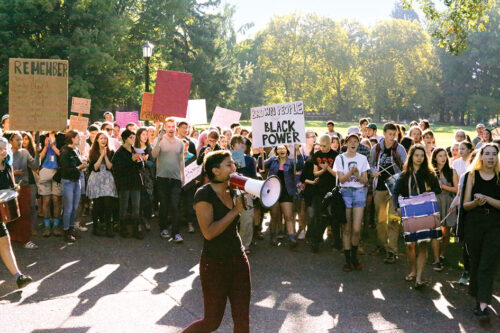
In 2016, the rising Black Lives Matter movement forced racial tensions to be brought to attention. At Reed, students criticized the use of Wells Fargo as the college’s operating bank, the low number of black tenure-track faculty, and for the college’s failure to support black students. A student group called Reedies Against Racism organized disruptive protests against the school’s mandatory freshman year Humanities course, which they criticized as Eurocentric. After a year of protests, dozens of faculty conferences, and dialogue sessions, the curriculum was overturned and units covering Harlem and Mexico City were added to the course.
Neither of these colleges succeeded in completely addressing the issues which catalyzed the protests. SF State never reinstated Professor George Murray, and the BSU was not given full discretion over the hiring and retention of Black Studies faculty. At Reed, professors and students still contend that the revised curriculum fails to effectively decenter Eurocentric perspectives, and institutional racism continues to be rampant on campus today. However, the significance of the victories won by students should not be understated. By the early 70’s, hundreds of Black Studies courses had been formed around the U.S.. Seemingly in lieu of a black studies program, Reed created a Critical Race and Ethnicity major in 2018. Without disruptive student actions which forced the administration’s attention, these changes would not have been possible.
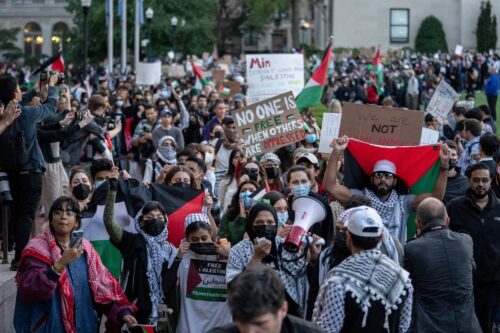
Unfortunately, the brutal suppression of student protests continues to plague the nation today. On April 29, 2024, Columbia University facilitated the arrest of over 100 students for occupying Hamilton Hall—a tactic reminiscent of the Anti-Vietnam War protests in 1968—in protest of the ongoing genocide in the Gaza Strip and the university’s endowment investment in Israeli companies. Students were suspended and even expelled for their part in the protests. Thousands of students, faculty, and activists were arrested across 60 different campuses for pro-Palestinian protests in 2024.
The SF State Strike remains in historic memory as a reminder of the importance of organized action; proof that significant victories can be hard-won with discipline and persistence. By giving me the chance to look into the history, the Freedom Archives helped me to understand how the world I live in was built and how people gave up their lives to change it years before I was born. Learning from the past has given me insight into how to change the future.
-Liwon Kim